Why Your Best Leads Are Fake, and the Platforms Charging You Know It
Federal courts have documented what most marketers already suspected. Meta, Google, and LinkedIn are running an industry where fake leads, inflated metrics, and paywall extraction are the business model, not the bug.
Let me tell you what is happening to your marketing budget.
Somewhere in the world, a bot network is filling out your lead forms with plausible looking names and burner emails. A click farm in a country your business has never operated in is generating traffic on ads you bought from Google. A scam display site you have never heard of is collecting commissions on impressions your campaign was forced onto by an algorithm you cannot opt out of. And the platforms collecting your money, Meta, Google, and LinkedIn, all know it is happening.
They know because their own internal documents say so. They know because federal courts have made them say so. They know because their own product teams have built clever little dialogs designed to upsell you on services that exist specifically to clean up the problems their other products created. And they keep charging you anyway.
If a guy in a boiler room in Mumbai called your grandmother and tricked her into wiring money to fix a Medicare problem she does not actually have, we would call that a scam. We would put him on the news. We would have the FBI raid the building. When a Fortune 500 tech platform does the structural equivalent at industrial scale, we call it digital advertising and we keep buying ads.
This article is the long answer to the question every honest marketer has asked themselves at three in the morning, staring at a CRM full of disconnected phone numbers: is the platform actually scamming me, or am I just bad at my job?
You are not bad at your job. The platforms are not impartial. The bots are not slowing down. And the evidence is now overwhelming, public, in federal court records, and increasingly being mocked by their own users on their own platforms.
Let me show you.
The numbers are not subtle
Before we talk about platforms, let me lay out what independent measurement firms have been quietly documenting for over a decade.
The 2025 Imperva Bad Bot Report, the most authoritative annual study of automated traffic on the internet, found that bots surpassed human traffic in 2024 for the first time in ten years. Bots are now 51 percent of all web activity. Bad bots, the kind specifically designed to deceive, are 37 percent. That share has grown for six consecutive years. The internet is more than half not human, and the worst half is the half marketers pay for.
Fraudlogix, an independent ad verification firm with no buy side or sell side conflicts of interest, analyzed 105.7 billion ad impressions in their Q1 2026 report. Their global invalid traffic rate was 20.64 percent. In the United States it was 23.69 percent. On desktop it climbed to 27 percent. One in four desktop ad impressions in America is bullshit, and someone is still being billed for them.
Juniper Research, the neutral analyst that most of the digital ad industry quotes when it suits them, projects global ad fraud losses will exceed 100 billion dollars in 2026 and reach 133 billion by 2028. The Association of National Advertisers documented 26.8 billion dollars in wasted programmatic ad spend, and that was before agentic AI showed up.
On Meta specifically, industry estimates put scam ads at roughly 10 percent of the company's 2024 ad revenue. Four to five percent of Meta's monthly active users are estimated to be fake accounts, and that is the floor. On TikTok, one analysis estimated 74 percent of ad clicks were bot driven. On Facebook, 57 percent. You can argue with any single methodology. You cannot argue with the direction. Every credible independent source points the same way.
So when your gut tells you something is off with your campaigns, your gut is right. The infrastructure of paid digital advertising has a bot problem so large that the question is not whether you are being charged for fake traffic. It is how much of your spend is going up in smoke.
How the scam actually works
There are three categories you need to understand. They overlap, but the mechanics differ, and so do the defenses.
Category one: classic click fraud
A scammer builds a low quality website, signs it up for an ad network like Google AdSense, and then sends bots or paid clickers to click the ads on their own site. Every click pays them a commission. The advertiser is billed. The platform takes its cut of every transaction, real or fake.
This is the oldest scam in pay per click and it should have been solved by now. It has not been solved. Modern bot networks rotate IP addresses, simulate human mouse movement, vary their click patterns, and route through residential and mobile proxies so every fake click looks like a unique device on a real consumer network. The 2025 Imperva report flagged the obvious: generative AI has lowered the barrier so far that any moderately competent attacker can now run advanced bot campaigns from a laptop.
Google's defense to this is that they detect invalid clicks and refund you. The reality is that their manual refund approval rate runs around 10 percent. They keep the other 90 percent.
Category two: lead form fraud
This is the one that grinds small businesses into dust.
The fraudsters got smarter. The platforms got better at detecting clicks with no follow through, so the bots evolved. Now they fill out lead forms with real looking data: plausible names, working email syntax, valid phone number formats. The platform sees a conversion event fire and reports it as a successful lead. You are charged. The scammer is paid. The lead is a ghost.
The scammers instruct their bots to look for leads forms on the advertisers websites, and to fill out the leads forms with real-looking data. This tricks the advertising network into believing the bots traffic is real, and the scammers are able to continue stealing money from advertisers.
Trey Vanes, Polygraph
You only find out the leads are junk when your sales team tries to call them. By then everyone has already been paid except you.
Here is the part the platforms do not want you thinking about. Those fake conversions actively poison your campaign optimization. Smart Bidding on Google, automated optimization on Meta, every algorithmic bidding system in the industry, they all learn from conversion events. When the conversion event is a fake lead, the algorithm concludes that traffic from bot networks is high value and starts pouring more of your budget at the placements that produced the fake leads in the first place. The algorithm is doing exactly what you trained it to do. You just did not realize that the platform let you train it on poison.
Category three: incentivized and recycled leads
More common than people realize. A bad affiliate sets up a landing page promising a gift card or a sweepstakes entry. People sign up because they want the freebie. The affiliate sells those contacts as leads. Same person, same throwaway email, sold to twelve advertisers in the same vertical.
The lead is technically real. There is a human at the other end. But there is zero buying intent. Your sales team burns a week trying to convert someone who never wanted what you sell, never will want it, and is annoyed you called.
The 2026 wildcard: agentic AI just made everything worse
Every previous generation of bot traffic could ultimately be caught by behavioral analysis. Humans hesitate. They scroll back. They mistype and correct themselves. They get distracted by notifications. Bots followed scripts. Once a verification firm modeled human behavior accurately enough, the bots stuck out.
That model is broken. Generative AI has produced a new class of autonomous agent that does not follow a script. Large language models can now power browsing agents that scroll at human speeds, pause on content as if reading, hesitate before clicking, and adapt their behavior to whatever page they encounter. DataDome measured nearly 8 billion AI agent requests across their network in just January and February of 2026. Some were legitimate. Many were not.
Experian's Future of Fraud Forecast for 2026 named agentic AI as one of the top fraud threats of the year. The cybersecurity industry calls these Generation Three attack agents. They are locally hosted, self directed, and equipped with reasoning capability. They do not just simulate a click. They simulate an entire customer journey.
From the perspective of an advertiser, this means the obvious tells are gone. The fake leads in 2026 are not gibberish. They are plausible names attached to plausible looking emails, submitted at plausible times of day, from IP addresses that look like real consumer broadband connections. The only way to know they are fake is to call them, and even then a slice of agentic AI submissions will pass casual phone verification because the AI is wired into a voice synthesis layer.
The platforms are years behind on this and have shown no urgency to catch up. We will get to why in the next section.
Why the platforms have not fixed it, and never will
Here is the thing nobody on a platform earnings call wants to say out loud.
In every digital advertising auction, the platform is paid before anyone knows whether the click or lead was real. Google charges you for the click. Meta charges you for the lead. LinkedIn charges you for the engagement. The money moves before the verification, and the verification is run by the same company that just collected the money.
Imagine if your bank ran its own audit, declined to publish its methodology, refused to let an independent firm inspect its books, charged you a fee to dispute charges, and approved 10 percent of disputes. That bank would not be in business. That bank would have an FBI building permanently parked in its lobby. That is, almost exactly, how the major ad platforms operate, and the entire industry has decided to call it normal.
A senior executive at a major ad verification firm was asked in a March 2026 industry interview what the financial risk would be for the major platforms if they failed to address agentic AI fraud. The answer was unusually direct:
That is a good question because they are not impartial. The major players reimburse some invalid clicks but do not catch everything, and our data shows manual refund requests have about a ten percent approval rate at Google. Further, it is not in their interest to really fix this issue.
Read the last sentence again. It is not in their interest to really fix this issue. That is the entire story of digital ad fraud in twelve words.
Compare this to traditional advertising. In print, broadcast, and out of home, publishers submitted their circulation and audience numbers to independent auditors like Nielsen and the Audit Bureau of Circulations. Those auditors had subpoena power, independent verification standards, and reputations that could be destroyed if they got it wrong. The digital world has the Media Rating Council, which exists, but accreditation is voluntary and most platforms have politely declined to subject their core metrics to the same level of scrutiny traditional media accepted as routine. They will tell you their internal detection systems are world class. They will not let anyone independent verify that claim.
There is a more uncomfortable point underneath all of this. Inflated metrics make the platforms more valuable. Higher reach numbers justify higher ad prices. More engagement signals make the algorithm look smarter than it is. More conversions make the conversion product look better than it is. Every platform has a finance team, an investor relations team, and a quarterly earnings call. None of those people are arguing that the platform's numbers should be lower.
If your business model depends on a number going up, and the number going up is partly fake, and an independent audit would prove it is partly fake, your business model is to never permit an independent audit. That is not a conspiracy theory. That is the strategy you would write in a deck if you were the platform.
Meta has been caught, and is fighting to keep the evidence from a jury
Meta's lead ads format has a design choice that makes the fake lead problem catastrophic for advertisers and great for Meta.
When someone taps a Facebook lead ad, the form opens inside the Facebook environment and is pre filled from their profile. One tap to submit. The conversion rate is dramatically higher than any web form because the friction is almost zero, which is what Meta sells. From a fraud standpoint, the same friction collapse is the problem. You cannot embed CAPTCHA. You cannot run honeypot fields. You cannot run third party validation scripts on the form. You are not running a form. Meta is running a form for you, and handing you whatever it decides came out the other side.
When that environment hands you a fake account, an accidental tap from someone scrolling, a duplicate from a profile that already submitted, or one of the 4 to 5 percent of Meta monthly active users estimated to be fake at any given moment, you have no defensive layer. You did not get a chance to vet. You just got billed.
Facebook has publicly reported removing more than 2.8 billion fake accounts in a single twelve month period. Two point eight billion. That number alone should end the conversation about whether Meta's environment can be trusted to deliver real humans. They cannot delete the fake accounts as fast as they get created, and they have built a lead generation product that bypasses every defensive measure an advertiser would normally put on their own form.
The case Meta has spent seven years and untold millions trying to bury
Now to the part that is in federal court.
DZ Reserve, et al. v. Meta Platforms, Inc., Case Number 3:18-cv-04978, Northern District of California, Judge James Donato presiding. Filed in 2018. Plaintiffs are former Meta advertisers who allege the company's Potential Reach metric, the number Facebook showed advertisers when they built campaigns, was systematically inflated. They allege Meta knew it was inflated. They allege Meta refused to fix it because of revenue.
This is not speculation. Documents unsealed during discovery show that senior Facebook executives, including former Chief Operating Officer Sheryl Sandberg, acknowledged internally as far back as 2017 that Potential Reach was misleading. One of the reasons it was inflated was that the metric included duplicate accounts and fake accounts. In August 2018, Facebook told advertisers it had a Potential Reach of 230 million American adults. U.S. census data at the time showed only 170 million American adults actually used the platform. Meta charged advertisers premium prices based on the bigger number while internally acknowledging the bigger number was wrong.
Class certified March 2022. Meta appealed. Ninth Circuit affirmed class certification by a 2 to 1 vote in March 2024. Meta petitioned the Supreme Court. The Supreme Court declined to take the case in January 2025. A jury trial was scheduled for October 14, 2025.
Then, with seven years of litigation behind them and the trial date weeks away, Meta filed a motion to compel arbitration. A maneuver they could have raised at any point in the prior seven years. A maneuver they did not raise. On December 2, 2025, Judge Donato denied it in an order that should be required reading for anyone who still thinks Meta is operating in good faith.
This case started in 2018, and in the seven years that have since passed, Meta mentioned the possibility of going to arbitration exactly once. Even so, on the eve of a jury trial scheduled to begin on October 14, 2025, Meta sailed in on August 21, 2025, a motion to compel arbitration. Overall, Meta waged a seven year campaign of litigating this case in two federal courts, and took full advantage of the procedures available in the court system, while staying silent about the arbitration agreement.
Judge James Donato
The October 2025 trial was vacated. Meta filed an interlocutory appeal to the Ninth Circuit, docketed as Case 25-7657. In March 2026, the plaintiffs fired back, accusing Meta of waiving arbitration through seven years of litigation conduct and trying to escape the courtroom only when the case was not going their way. As of this writing, no new trial date has been set.
Read the procedural history and ask yourself what an innocent defendant does. An innocent defendant goes to trial and clears its name. A defendant that knows what is in its own unsealed internal documents files a seven year procedural war designed to make litigation so expensive that the plaintiffs settle for less than the documents are worth.
The plaintiffs estimate damages around 7 billion dollars. Meta's behavior in 2025 and 2026 tells you what they think a jury would award.
LinkedIn is the same scam in a nicer suit
LinkedIn gets cultural cover that Meta does not. The audience is professional. The cost per click is high enough that buyers assume the platform must be cleaner. The interface looks like a corporate boardroom instead of a teenager's bedroom. The branding works hard to convince you that you are in a different category of internet entirely.
You are not. LinkedIn has its own federal lawsuit. LinkedIn has its own admitted years of metric inflation. LinkedIn has its own bot problem so large that the company deploys deep learning models to detect AI generated profile photos. And LinkedIn has built a paywall ecosystem so aggressive that working professionals are now openly calling it a scam in the comments on LinkedIn itself.
LinkedIn settled a class action over inflated ad metrics in 2024
November 2020: LinkedIn quietly disclosed that its own engineering team had found two measurement bugs that overstated video views and ad impressions on sponsored content for more than two years. 418,000 advertisers affected. LinkedIn issued refunds and credits, brought in third party auditors, and hoped that would be the end of it.
It was not. Two technology recruiting firms, TopDevz and Noirefy, filed a class action alleging that LinkedIn had been counting video ad views even when the videos played off screen because users had scrolled past them, and that LinkedIn was knowingly counting clicks generated by fake accounts and automated systems.
LinkedIn settled in 2024 for 6.625 million dollars. The settlement covered every U.S. advertiser who bought through LinkedIn Marketing Solutions between January 2015 and May 2023. As is standard, LinkedIn denied wrongdoing in the settlement language. They also agreed to bring in an outside auditor to review their click and impression metrics for at least two years, which is not what you do when you have nothing to hide. You bring in auditors when the regulators are circling.
Two of the largest ad platforms in the world have now both ended up in federal court over the integrity of their ad metrics. Meta is fighting tooth and nail. LinkedIn paid up and quietly agreed to be audited. This is no longer an isolated complaint from frustrated marketers. This is a pattern.
The fake account problem they cannot solve
LinkedIn has been more public than Meta about its efforts against fake accounts. The company removed more than 200 million fake accounts in a recent reporting period. It has rolled out user verification tools. It runs deep learning models that claim to detect 99.6 percent of AI generated profile photos.
Translate that public relations language honestly: LinkedIn is in a constant, expensive war against the volume of fake accounts on its own platform, and the fake accounts are winning often enough that the company has to publish hundred million account takedown numbers to reassure advertisers. The same networks that build inauthentic LinkedIn profiles fill out lead generation forms, generate ad engagement, and inflate the metrics the company sells to advertisers.
Spider AF documented one LinkedIn advertiser collecting 400 invalid leads in 60 days. LinkedIn cost per clicks routinely run 8 to 15 dollars. Do the math on what a fake lead costs. LinkedIn's official guidance on refunds for invalid clicks is, in practical terms, do not bother.
The Services Marketplace paywall, in screenshots from my own account
Let me show you something concrete. I manage the LinkedIn company page for a law firm called Barnes Walker, where I serve as Director of Marketing. The screenshots that follow come from that account. If you are republishing this kind of evidence yourself, I recommend redacting third party names before doing so. Mine show what I actually see.
LinkedIn operates a product called Services Marketplace. Businesses create a Service Page listing their offerings. LinkedIn members searching for those services submit Service Requests through the platform. Inbound requests show up in a Requests inbox tied to the page.
Here is the email notification LinkedIn sent me for one such request.
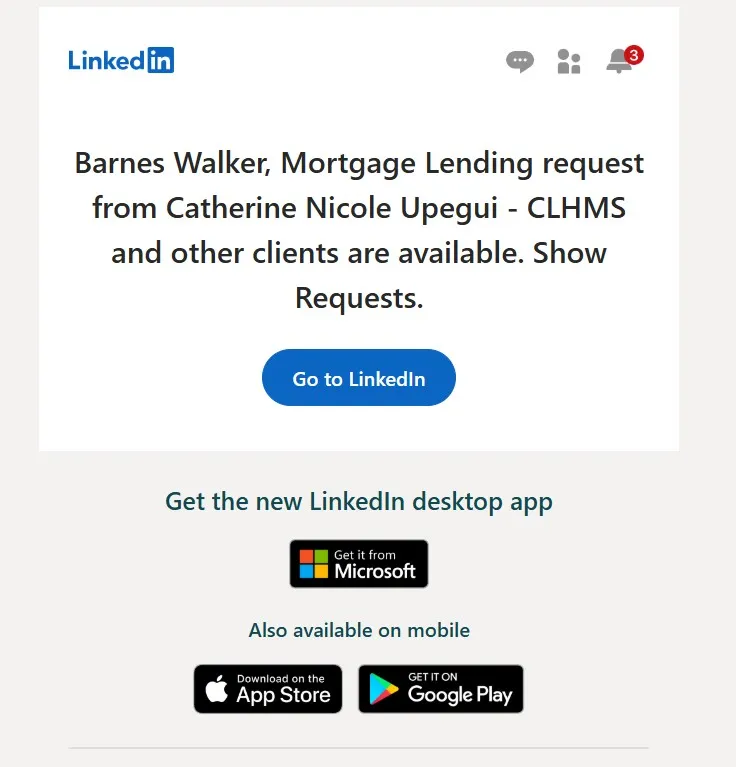
Notice the phrasing. A specific named person submitted a request, "and other clients are available." That second clause is doing the work. It manufactures the implication of multiple inbound opportunities. It creates urgency. It is the digital equivalent of a salesman saying "there are several other people interested in this car" while you stand in the driveway.
Click through and you land in the Requests inbox.
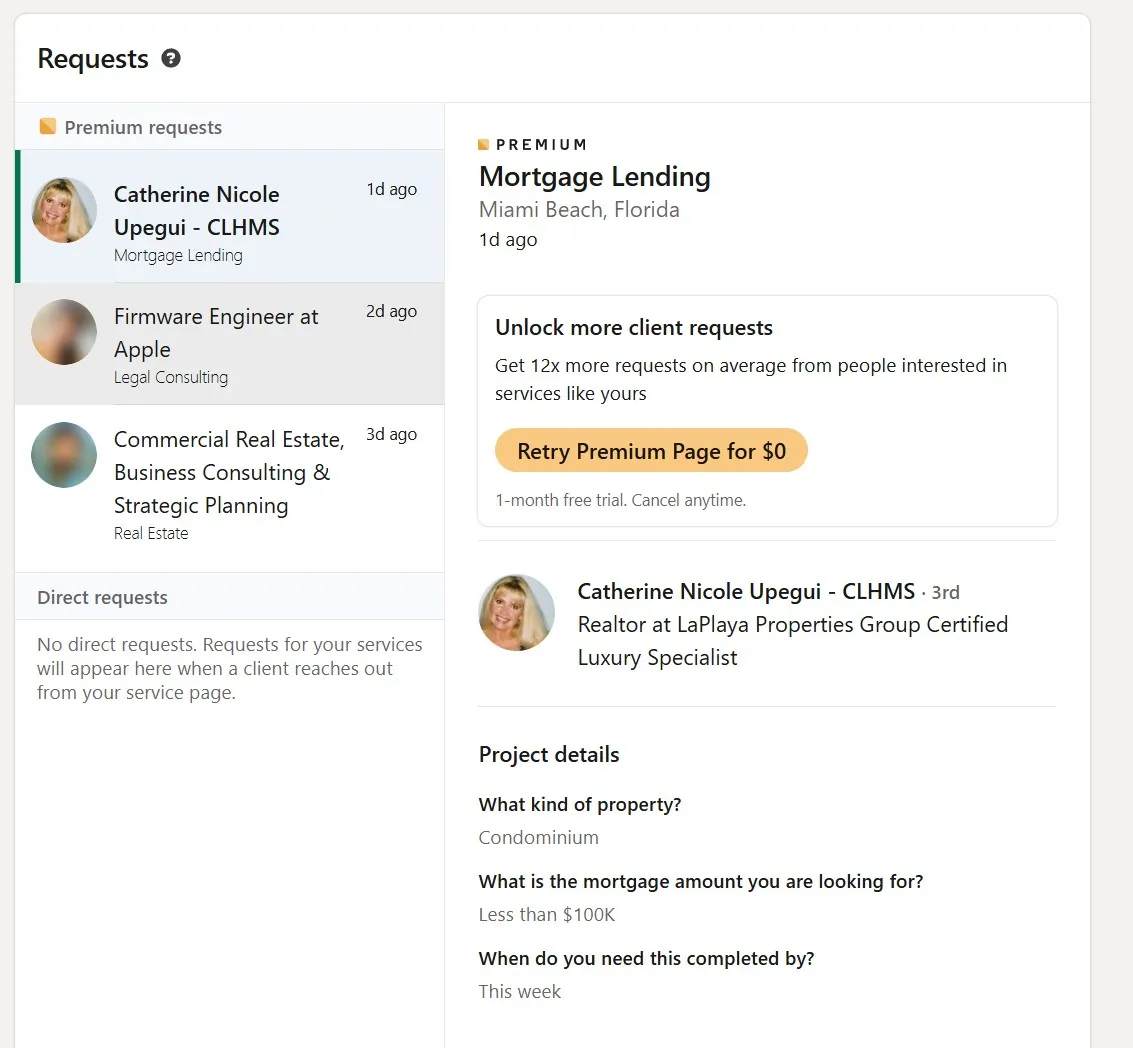
Look at what is on the screen. Three Premium Requests on the left. One visible. Two blurred. On the right, a panel titled "Unlock more client requests" promising that I will get 12x more requests on average if I upgrade. A yellow button reading "Retry Premium Page for $0." One month free trial. Cancel anytime.
The word "retry" is interesting. It implies I previously declined the trial and LinkedIn is asking me to reconsider. I have never accepted a Premium trial on this account, which means the language is calibrated to suggest persistence is required to refuse. The button is yellow because yellow converts. The price is zero because the trial converts to paid. Nothing on this screen is accidental.
Now look at the visible request. A Miami Beach realtor identified on LinkedIn as a Certified Luxury Specialist at LaPlaya Properties Group. Project details: Mortgage Lending, condominium, less than 100K, needed this week.
This request makes no sense on its face. A luxury specialist realtor in Miami Beach is supposedly asking a law firm in Bradenton, Florida for a mortgage on a sub 100K condo with a one week timeline. The geography is wrong. The amount is implausible for the source. The timeline is unrealistic. And the business category, mortgage lending, is not even Barnes Walker's primary service. The platform has matched our Service Page to a request that does not fit on multiple independent dimensions, and it has done so to drive me to upgrade so I can see the two other requests it is hiding behind the blur.
If the visible lead is this poorly matched, what is the over under on the blurred leads?
I do not know for certain whether this person actually submitted this request through LinkedIn, whether the matching algorithm inferred her interest from her profile, or whether the lead was generated some other way. What I know is the lead does not pass a basic sanity check, and yet it has been packaged and displayed in a UI designed to extract a credit card from me before I can see what else might be sitting in the queue.
This is not happening once. This is the weekly reality of managing a Services Marketplace page on LinkedIn for a real business. Every week, some variation of this exact mechanic plays out.
The verification trust paywall, and the public revolt against it
The Services Marketplace example is the lead side. There is a sibling mechanic on the engagement side, and the broader market is no longer being polite about it.
When you publish a post on LinkedIn, the confirmation dialog now looks like this.
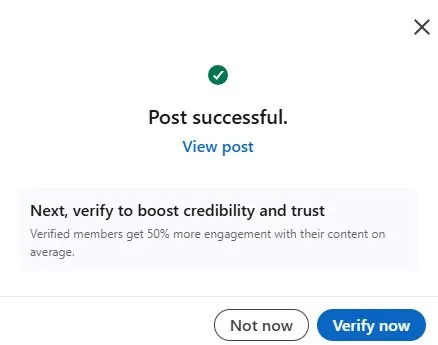
Read what this screen is actually doing. You published a post. The green checkmark says it worked. The headline beneath it says "Next, verify to boost credibility and trust. Verified members get 50% more engagement with their content on average." Two buttons. Not now. Verify now.
In the design research community this has a name. It is called a dark pattern. The dialog is dressed up as a success confirmation but it is functionally an upsell. The implicit message is that your post is going to underperform unless you pay roughly 30 dollars a month for LinkedIn Premium. The unstated corollary is that LinkedIn has somehow set things up so that the natural state of your content is suppression, and the unsuppressed state is something you rent monthly.
In April 2026, a Sydney based marketer and copywriter named Amy Jacobson posted on LinkedIn calling this out in plain language.
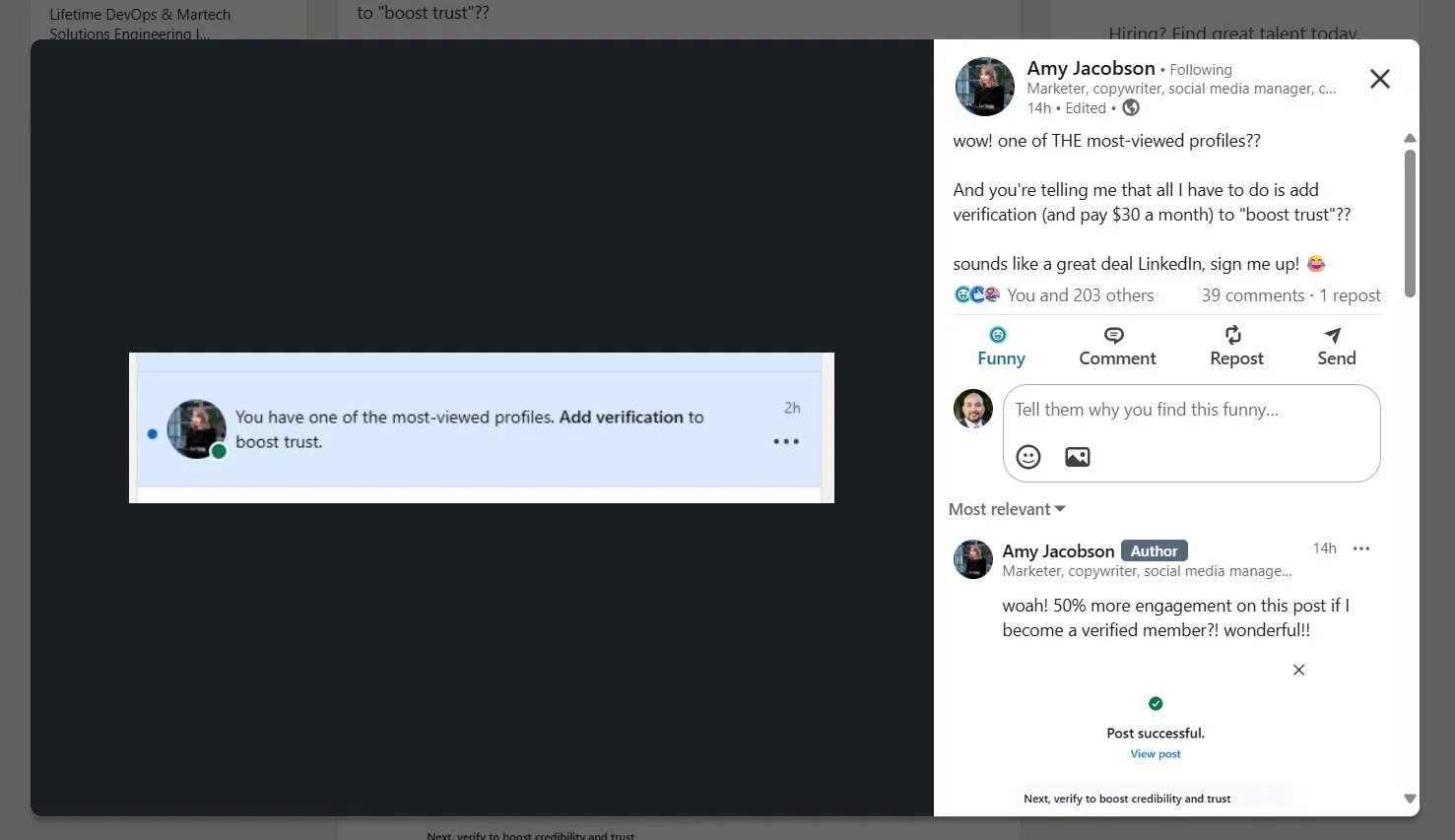
Her post reads: "wow! one of THE most-viewed profiles?? And you're telling me that all I have to do is add verification (and pay $30 a month) to boost trust?? sounds like a great deal LinkedIn, sign me up!"
The post collected over 200 reactions and 39 comments within fourteen hours. The comments matter more than the post.
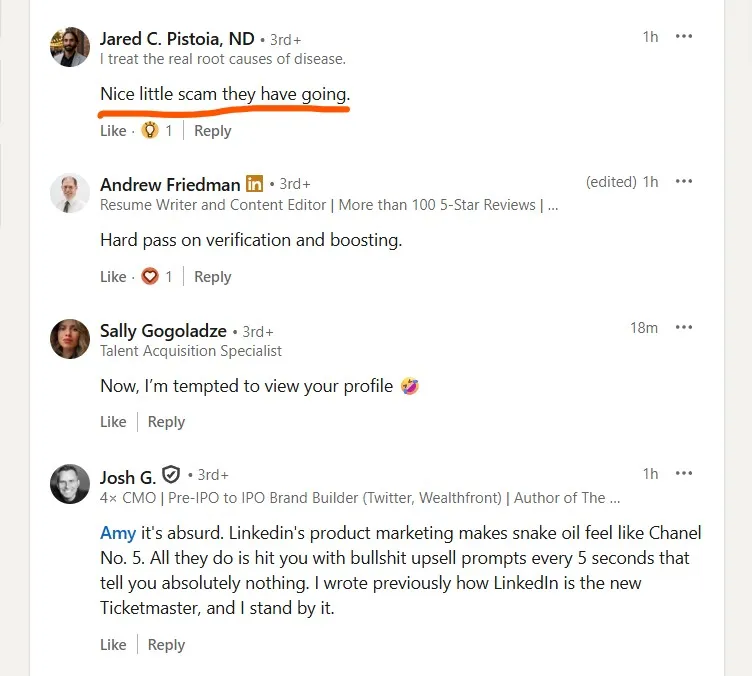
Look at who is talking and what they are saying.
Jared C. Pistoia, a healthcare practitioner, writes: "Nice little scam they have going." He uses the word scam, attached to his real name and credentials, on LinkedIn's own platform, about LinkedIn's own product. A scam. Not a quirk. Not a misfeature. A scam.
Andrew Friedman, a resume writer with over 100 five star reviews, writes: "Hard pass on verification and boosting."
Sally Gogoladze, a talent acquisition specialist, writes: "Now, I'm tempted to view your profile." Which is a joke, but the joke is that LinkedIn's manufactured scarcity is so transparent that watching it backfire on the platform's own messaging is itself entertaining.
The sharpest comment comes from a former CMO with experience at major tech companies including Twitter and Wealthfront. He writes that LinkedIn's product marketing "makes snake oil feel like Chanel No. 5," that the platform's upsell prompts every five seconds "tell you absolutely nothing," and that LinkedIn is "the new Ticketmaster." The Ticketmaster comparison is the tell. People only invoke Ticketmaster when they feel they are being held captive by a monopolist running predatory pricing on a service they cannot avoid using.
These are not anonymous trolls. These are working professionals using their real names and credentials, in public, on the platform in question, openly identifying its monetization design as a scam. The scam framing is no longer mine alone. It is the market's read.
Step back and tally what is now on the public record about LinkedIn. Federal class action settled in 2024 for 6.625 million dollars over inflated metrics, with mandated outside audits. A Services Marketplace product that hides inbound leads behind a paywall even when the visible leads are nonsense. A post confirmation dialog that disguises subscription upsells as success notifications. Sales Navigator at roughly 100 dollars per user per month, in part to give advertisers tools to manage the lead flow the platform itself controls the quality of. And a public market reaction openly using the word scam.
Each piece is individually defensible as a product decision. Together they describe something else.
The honest description of the LinkedIn business model
Strip away the corporate language for a minute. Here is what LinkedIn is actually doing, mechanically.
Step one: build a free product good enough that nearly every professional in the world feels they have to be on it. Step two: tune the engagement algorithm so that posts naturally underperform unless boosted, so users feel their content is invisible. Step three: gate the visibility of inbound leads, profile views, and "who's interested in your services" behind a Premium paywall. Step four: send relentless upsell prompts disguised as success notifications, system messages, and helpful tips. Step five: charge 30 dollars a month for verification, 100 dollars a month for Sales Navigator, more for Recruiter, all with auto renewal and a friction designed cancellation flow.
If a guy in a Bangladeshi call center built that exact same machine on a smaller scale, complete with manufactured urgency, gated information, and subscription upsells, we would call the State Department. Because LinkedIn is publicly traded, owned by Microsoft, and run by people in Sunnyvale offices, we call it a SaaS business.
The mechanics are the same. The legal department is what is different.
The structural argument that ties it all together
I am being careful with my language because I am making a structural and economic argument, not accusing any specific employee of fraud. The distinction matters legally.
LinkedIn makes money in several connected ways: ads, Premium subscriptions, Sales Navigator, Recruiter licenses, and InMail credits. The platform's economic interest is in keeping users on the platform, engaging with content, and triggering the moments that lead to a paid action. When an advertiser uses LinkedIn lead generation forms, LinkedIn is the conversion environment. When the lead lands in your CRM, your follow up often involves returning to LinkedIn to look at the person's profile, message them, or use Sales Navigator to research their company. Locked profile? Click Unlock full profile. Want to message someone outside your network? You need InMail credits. Want to see who has been requesting your services? Pay for the Premium trial.
Every lead, real or fake, drives you back to the platform. Every return visit is monetized. If you receive 20 leads and 3 are real, the platform still benefits from the engagement on the other 17, because each interaction trains the algorithm, increases time on platform, and creates new opportunities to sell you the tools to manage your pipeline.
Now imagine the alternative world. Every lead verified human, verified intent, verified accurate before it ever reached your CRM. Lead volume drops by half. Time on platform drops. The ROI case for Premium and Sales Navigator gets much harder to make. The platforms have no economic reason to build that world. They have every economic reason to build the world we currently live in, which is one where leads are plentiful, of dubious quality, and best managed by purchasing more platform tools.
That is the gray area. Not fraud in the criminal sense. Just a business model where the bug is the feature, the feature is monetized, and the cost falls on advertisers.
In 2026, with agentic AI making bot detection harder than ever, that misalignment is not narrowing. It is widening.
Google Performance Max, the most aggressive extraction of all
If LinkedIn is the same scam in a nicer suit, Google Performance Max is the same scam wearing a lab coat and holding a clipboard.
Performance Max, or PMax, is Google's machine learning powered campaign type that places your ads across the entire Google network: Search, Display, YouTube, Gmail, Discover, Maps, and the Search Partner Network. Google's pitch is that you hand over creative assets and a conversion goal, and the algorithm optimizes placement. Trust the machine.
The machine has a problem. When the automated bidding system encounters a placement producing high volumes of cheap conversions, the algorithm sends more budget there. If those conversions are fake leads from bot traffic, the algorithm cannot tell. It just sees the conversion event firing and concludes the placement is high value. This is the closed loop fraudsters have been exploiting since PMax launched.
A scammer sets up a low quality content site, gets it accepted into the Display Network, generates bot clicks on the ads showing there, and then has the same bots submit fake leads to your forms. PMax sees the cheap conversions, decides the placement is gold, and pours your budget into the trap. You are paying twice: once for the click, once for the fake lead that confirmed the click was "valuable."
Kasim Aslam, founder of Solutions 8 and one of the most respected Google Ads practitioners in the industry, has been about as direct as anyone working in this space can afford to be:
We are finding ways to fight bot traffic, and it is hard, it is a pain. And it inhibits our ability to use Performance Max. We are still having a hard time with PMax for lead generation. Every sales call I do with a lead generation client is like, well, it can work, here are the problems, change your entire conversion stack. I just wish we had more help from Google.
Kasim Aslam, Founder of Solutions 8
Translation: a top tier expert with a paid agency relationship to Google is publicly saying that Google's own flagship campaign type is so broken for lead generation that he has to overhaul his clients' entire tracking infrastructure to compensate. And Google's response has been silence.
Google added channel level reporting to Performance Max in early 2026. After years of escalating advertiser complaints. After PMax had been in market for four years. After every major agency in the industry had documented the fake conversion problem. Even now, the new reporting only tells you which channel produced your conversions. Placement level transparency, the ability to see which specific website on the Display Network actually generated a given conversion, remains opaque on PMax in a way it is not on standard Display campaigns.
You can see a conversion came from Display. You generally cannot see that your home renovation lead form was submitted 14,000 times on a click farm content site in a country where your business does not even operate.
That is not an oversight. That is a feature.
Practitioner reports through late 2025 and into 2026 have consistently flagged a pattern where PMax campaigns produce a flood of fake leads early in their run, then gradually self correct over three to four weeks as the algorithm shifts spend. Some advertisers have reported pausing PMax entirely, watching the fake leads disappear instantly, and reintroducing the campaign type with much tighter controls. The fake leads are not random. They are a structural artifact of how PMax interacts with the worst parts of the Display Network.
Google's defense is that you should trust the algorithm. The algorithm is being trained on garbage. The garbage is being supplied by a network that Google is paid for every interaction on. The advertiser bears the cost. Google takes the cut.
Defense, because the platforms will not save you
None of this changes overnight. The lawsuits will take years to resolve. The platforms will not voluntarily clean their own houses. Agentic AI will keep getting better at impersonating real humans. The only real defense is what you build on your side of the wall.
Validate every lead before it touches your CRM
Use real time email validation services like ZeroBounce, NeverBounce, or BrightVerify on every form submission. For phone numbers, use Twilio Lookup or Numverify to flag disposable, VOIP, or invalid numbers before your team picks up the phone. Cost is fractions of a penny per lookup. The hit rate on obvious junk justifies it within the first week.
Lead scoring should require post-submission behavior
A real lead leaves a trail. They visit your site again, read a case study, open a follow up email. A fake lead is silent after submission. Build a scoring model where leads only advance to the sales team after they show some kind of return signal. Submitted and never seen again is the signature of a bot. Treat it that way.
Require TrustedForm or LeadiD certificates from paid lead vendors
If you are buying leads from affiliates or third party generators, every lead should come with a session replay certificate. TrustedForm and Jornaya LeadiD both record how the form was actually filled out, by what device, with what mouse movements. Not perfect. Significantly harder to fake.
Cut the placements you cannot trust
On Google Ads, build aggressive exclusion lists for display partner sites. Consider opting out of the Search Partner Network. On Meta, exclude the Audience Network. On PMax, use the 2026 channel level reporting to identify where conversions are actually coming from and adjust your asset groups accordingly. Yes, you will lose some reach. Yes, your CPL will look worse on the dashboard. Your actual lead quality will improve dramatically.
Optimize toward verified outcomes, not platform conversions
This is the single highest leverage change you can make. Stop letting the platform's conversion event be your optimization target. Send your CRM's qualified lead status or closed deal back to the platform via offline conversion uploads or the Conversions API. Force the algorithm to learn from real outcomes, not dashboard theater. It is more work to set up. It is also what separates accounts that grow from accounts that bleed.
Audit weekly, not quarterly
Every Monday, look at your CRM data. Repeated fake company names. Disposable email domains. Geographic clusters that do not match your customer base. Phone numbers that route to the same area code over and over. Submission timestamps clustered at hours nobody in your market would be filling out a form. The longer you wait between audits, the more the bad data gets baked into your algorithm.
Refuse to pay for gated leads
If a platform is dangling blurred leads behind a paywall, treat that as a warning sign, not a sales pitch. The platform has every incentive to surface those leads in whatever way maximizes your upgrade probability, regardless of whether the leads are real or qualified. Ask yourself two questions before paying. First, what is the platform's incentive to ensure those leads are valuable to me? Second, has the platform ever given me a free lead that converted to real revenue? If the second answer is no, the first answer matters a lot.
Use a click fraud protection layer if you spend real money
Lunio, ClickCease, Anura, Spider AF, ClickGuardian, FraudBlocker. None of these are perfect. All of them are better than nothing once your monthly ad spend is above a few thousand dollars. The platforms have made very clear they will not protect you. Outside vendors are the only practical option.
File refund requests anyway
The manual refund approval rate at Google is reportedly around 10 percent. File anyway. Document the patterns. Submit the evidence. A 10 percent recovery rate is better than zero, and every documented refund request is a data point that future class action attorneys will rely on. Be part of the paper trail.
The honest conclusion
I am not telling you to stop running Facebook ads. I am not telling you LinkedIn is unusable. I am not telling you to abandon Google. Most of my clients run profitable campaigns on multiple platforms simultaneously, and the campaigns work when they are built and managed by someone who understands what is actually happening on the other side of the dashboard.
What I am telling you is this. The relationship between advertisers and platforms is structurally tilted, and the imbalance is not an accident. Meta has been in federal court since 2018 over inflated metrics, has lost at every level, and is now using every procedural tool available to delay a jury verdict its own unsealed documents suggest will be devastating. LinkedIn paid 6.625 million dollars in 2024 to settle a similar case, while its product teams continued building paywall mechanics so aggressive that working professionals are now openly calling the platform a scam in its own comment sections. Google built an automated campaign type that systematically misroutes advertiser budget into fraud networks, sat on the problem for years, and finally added partial transparency only after sustained external pressure. Independent traffic firms report invalid traffic rates above 20 percent. Bots now exceed humans on the internet. Agentic AI is widening the gap every month.
This is not a conspiracy theory. It is the public record, supplemented by what any practitioner managing real accounts can document from their own dashboards.
When a small business owner tells me they ran a Facebook campaign, got 20 leads, and only 2 were real, they are not failing at marketing. They are running into the same structural problem that thousands of other advertisers have hit, that federal courts have ruled on, and that the platforms themselves have privately acknowledged in their own internal documents. The shame is not theirs. It belongs upstream.
The mechanics of a scam are simple. Manufacture urgency. Gate the information. Refuse to refund. Run the volume up. The boiler room operator running a phony Medicare scam from a basement office in another country does exactly this, just at a smaller scale and with a worse legal department. The major ad platforms do it at industrial scale with a Fortune 500 logo, a public stock price, and a PR team that will sue you for saying so out loud.
So I will not say it. Not exactly. I will say that the structural mechanics overlap suspiciously, that the federal court record speaks for itself, and that the market is now openly using the word scam in public on the platforms' own products. You can draw your own conclusions about what that means.
The way forward is the same as it has always been when an industry is structurally dishonest with its customers. Stop trusting the dashboard. Start trusting the CRM. Validate every lead. Optimize toward verified outcomes. Audit relentlessly. Treat every platform conversion event as a claim to be checked, not a fact to be celebrated. Assume some percentage of what you are paying for is not real, because the data overwhelmingly says it is not.
Once you stop trusting the platforms and start trusting your own ground truth, the noise filters out, the real signal becomes legible, and the conversation you have with yourself about your own marketing performance becomes a lot more honest.
That is where good marketing decisions actually live. Not in the platform's reports. Not in their dashboards. Not in their dialogs. In the ground truth of who picked up the phone and bought something.
Everything else is theater, and you are paying for the tickets.
Sources and Further Reading
- Imperva, 2025 Bad Bot Report. Bot traffic surpassed human traffic at 51 percent of all web activity in 2024.
- Fraudlogix, 2026 Q1 Ad Fraud Statistics Report. Global invalid traffic rate of 20.64 percent across 105.7 billion analyzed impressions.
- Juniper Research, projections of $100 billion plus in global ad fraud losses for 2026, rising to $133 billion by 2028.
- DataDome, AI Traffic Report covering nearly 8 billion AI agent requests in January and February 2026.
- Experian, Future of Fraud Forecast 2026, naming agentic AI as a top fraud threat.
- DZ Reserve, et al. v. Meta Platforms, Inc., Case No. 3:18-cv-04978, U.S. District Court for the Northern District of California.
- Cohen Milstein, Facebook Potential User Reach Litigation case overview and procedural updates.
- Courthouse News Service, coverage of Judge Donato's December 2, 2025 order denying Meta's motion to compel arbitration.
- MediaPost, March 2026 coverage of advertisers responding to Meta's 11th hour arbitration bid at the 9th Circuit.
- CNBC, Facebook knew ad metrics were inflated but ignored the problem to make more money, lawsuit claims.
- TopDevz and Noirefy v. LinkedIn Corporation. Settlement of $6.625 million in 2024.
- Ad Age, LinkedIn discloses inflated metrics glitch that led it to overcharge 418,000 advertisers, November 2020.
- Reuters, Microsoft's LinkedIn settles advertisers' lawsuit over alleged overcharges.
- Polygraph press releases on fake leads scams affecting Google Ads and Performance Max campaigns.
- Spider AF, 2025 Ad Fraud White Paper and 2026 Ad Fraud Investigation Report.
- Fraud Blocker, Lead Generation Fraud research and LinkedIn bots analysis.
- Lunio.ai, Lead generation fraud research featuring commentary from Kasim Aslam of Solutions 8.
- BetaNews, March 2026 Q&A on agentic AI and ad fraud.
- Web Eminence, practitioner case study from January 2026 on PMax fake conversions.
- LeadsOff, Performance Max Fake Lead analysis from 2026.
- Association of National Advertisers, programmatic ad spend waste research.
- World Economic Forum, Global Cybersecurity Outlook 2026.
Frequently Asked Questions
How much of my ad budget is going to fake clicks and bot traffic?+
Independent measurement firms report that bots now comprise 51 percent of all web traffic, with bad bots at 37 percent. Fraudlogix measured a 20.64 percent global invalid traffic rate across 105.7 billion ad impressions in Q1 2026, climbing to 27 percent on desktop in the United States. Juniper Research projects global ad fraud losses will exceed 100 billion dollars in 2026. The exact percentage for your specific campaigns depends on your industry, geography, and which platform products you use, but the floor is significantly higher than most advertisers assume.
Has Meta been sued over inflated advertising metrics?+
Yes. DZ Reserve v. Meta Platforms (Case 3:18-cv-04978, Northern District of California) alleges that Meta's Potential Reach metric was systematically inflated with duplicate and fake accounts. Internal documents show executives acknowledged the inflation as early as 2017. Class was certified in 2022, affirmed by the 9th Circuit in 2024, and the Supreme Court declined review in January 2025. Plaintiffs estimate damages around 7 billion dollars. Meta filed a last-minute motion to compel arbitration, which was denied in December 2025.
What can I do to protect my ad budget from click fraud?+
Validate every lead with email and phone verification services before it touches your CRM. Use lead scoring that requires post-submission behavior. Cut untrusted placements by excluding Display Network partners and the Audience Network. Optimize toward verified CRM outcomes instead of platform conversion events. Use click fraud protection tools like Lunio, ClickCease, or Anura. Audit your CRM data weekly for patterns of fake submissions. File refund requests with the platforms even though the approval rate is low, because the documentation trail matters.