
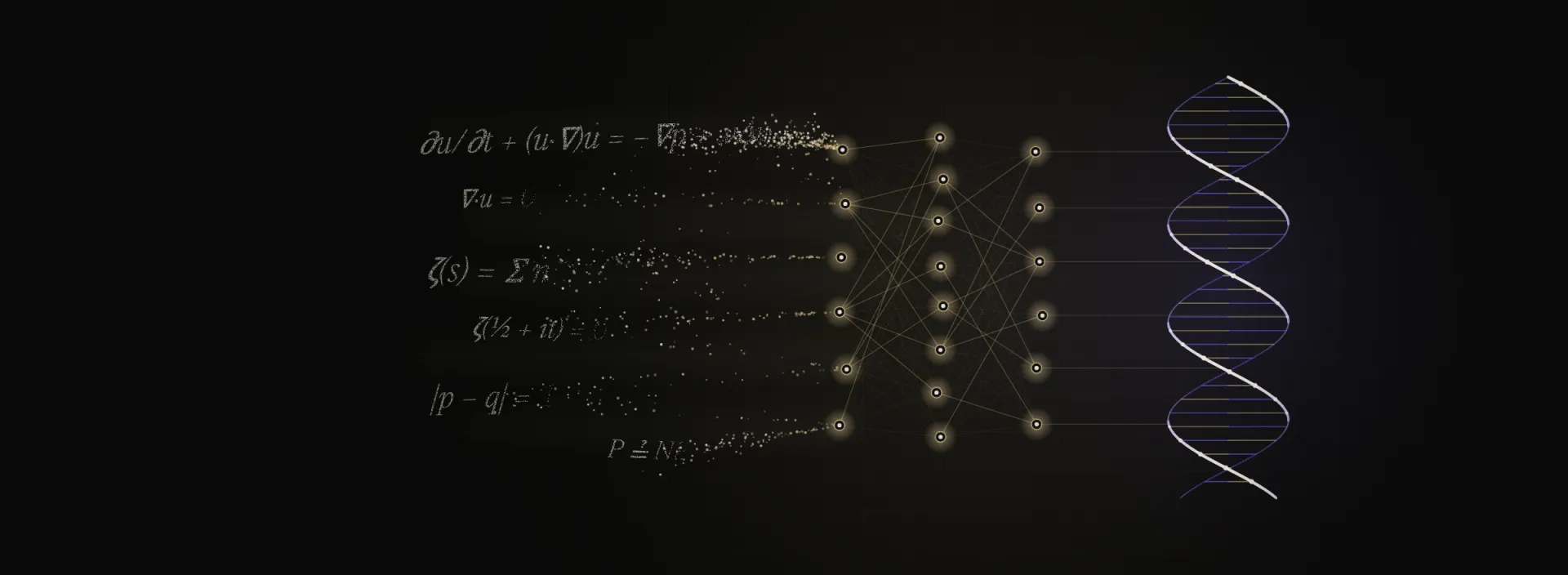
"I am currently completely overwhelmed with an existential crisis in my field."
That is not a nervous graduate student talking. That is Terence Tao, the UCLA Fields Medalist widely described as the greatest living mathematician, speaking to AFP in September 2026. Weeks earlier, at the International Congress of Mathematicians, a newly crowned Fields Medalist named Jacob Tsimerman accepted the highest honor in mathematics and announced, on the same day, that he was leaving his professorship to work on AI safety at OpenAI.
Meanwhile, an AI system disproved a geometry conjecture that had stood since 1946. OpenAI claimed a solution to one of the seven $1 million Millennium Prize Problems. A generative AI drug entered Phase III trials. Genome models started reading a million letters of DNA at once. And early career workers in AI exposed jobs quietly stopped getting hired.
I have spent the last few years building AI systems inside a law firm and watching how professionals react when the machine starts doing the part of their job they thought made them special. This article is my attempt to separate what is actually happening from the hype, and to answer the harder question: when experts push back, how much of it is legitimate critique and how much of it is ego?
1. The Week Math Changed: The Navier-Stokes Story
The Navier-Stokes equations describe how fluids move: water in a pipe, air over a wing, blood in an artery. Engineers use them every day. Yet for nearly two centuries, nobody could prove whether smooth solutions always stay smooth or whether they can "blow up," meaning the math predicts infinite speed in finite time. In 2000 the Clay Mathematics Institute made it one of seven Millennium Prize Problems, each worth $1 million. Only one of the seven, the Poincaré conjecture, had ever been solved.
On September 8, 2026, OpenAI announced that an unreleased internal model had proven finite time blowup for the three dimensional Navier-Stokes equations. The numbers were staggering:
- Roughly 10,000 AI agents working in parallel
- About 88 hours from launch to proof
- Around 130 billion output tokens
- An estimated $6 million to $10 million in compute, based on NPR's math using OpenAI's public pricing
- A paper of more than 160 pages plus a formal proof in the Lean proof assistant
OpenAI also said it would not claim the $1 million prize.
The asterisk: "forced" blowup
OpenAI's proof gives the fluid a smooth, continuous push from outside, called a forcing term. Here is the twist: the Clay Institute's official problem statement actually allows that. It contains four possible answers, and two of them permit a forcing term. So calling the result fake is wrong. But the version most mathematicians care about, whether a fluid with no outside push can blow up on its own, remains open. Some researchers have already published arguments that this style of construction cannot settle the unforced case, and others question whether the Lean formalization matches the written proof.
What the Clay Institute actually said
Three days later, Clay said it shared the excitement of the global math community at the announcement that the problem had "apparently" been settled. Its president, Martin Bridson, said evaluation would be "deliberately unhurried" and "absolutely rigorous." Clay still lists the problem as unsolved. Its rules require publication in a qualifying outlet, a two year waiting period, and general acceptance by the community. No prize can be awarded before roughly 2028.
The fight over credit
The day before OpenAI's announcement, NYU mathematician Tristan Buckmaster posted his own blowup proof for the Euler equations, the frictionless cousin of Navier-Stokes. He had spent nearly a year on the approach with Levent Alpöge, a mathematician at Anthropic, using AI models. Buckmaster says OpenAI was tipped off to their route and offered him coauthorship terms he found unacceptable. OpenAI denies seeing their work, though it acknowledged that rumors of a breakthrough prompted its attempt and that it could not rule out a contribution from deidentified product data.
NPR summed up the mood with a brutal headline: "AI solved one of math's hardest problems. Humanity learned nothing (so far)."
2. The Millennium Prize Scorecard: What Was Really "Solved"
Social media made it sound like AI was knocking out Millennium Problems one per week. Here is the honest status as of November 2026.
| Problem | Who and When | What Was Actually Shown | Honest Status |
|---|---|---|---|
| Navier-Stokes | OpenAI, Sept 2026 | Blowup with an outside forcing term | Serious claim. Clay says "apparently" settled, no award. Unforced case open. |
| Riemann Hypothesis | Anthropic (Aug 2026), OpenAI (Oct 2026) | Reported increase in the proven share of zeros on the critical line | Partial progress. Neither lab claims a proof of the hypothesis. |
| Hodge Conjecture | OpenAI, Oct 2026 | Special cases only | Three companion papers withdrawn after a sign error. |
| Birch and Swinnerton-Dyer | OpenAI, Oct 2026 | Limited low rank cases | Under investigation. No progress on the general problem. |
| P vs NP | OpenAI and Anthropic, Oct 2026 | Claimed refutations of the Exponential Time Hypothesis | Unconfirmed. Even if correct, it does not settle P vs NP. |
| Yang-Mills Mass Gap | OpenAI, Oct 2026 | Announced existence of the theory, no mass gap | Materials not released. |
| Poincaré Conjecture | Grigori Perelman, 2003 | Full proof, no AI | The only solved Millennium Problem. Prize declined. |
Two lessons jump out. First, the volume itself became a problem. MIT's Ryan Williams called OpenAI's October flood of claimed proofs a "DDOS attack on mathematicians" before agreeing to help vet one of them. Second, a machine checked proof is only as good as the statement it checks. As Thomas Hales argued on Tao's blog, a human still has to confirm that the formal Lean statement says what everyone thinks it says.
Bottom line: AI has made genuine progress on the hardest problems in mathematics. It has not "solved the Millennium Prizes." Anyone telling you otherwise is selling something.
3. The Math Breakthroughs That Are Real
From embarrassment to milestone in seven months
In October 2025, an OpenAI executive tweeted that its model had solved ten previously unsolved Erdős problems. Thomas Bloom, who runs the Erdős problems database, called it "a dramatic misrepresentation." The model had found existing papers, not new proofs. Google DeepMind CEO Demis Hassabis called the episode "embarrassing," and the tweet was deleted.
Then the story flipped:
- January 2026: Two researchers used an OpenAI model to solve Erdős Problem #728, with the proof machine checked in Lean by Harmonic's Aristotle system.
- Spring 2026: A DeepMind agent resolved 9 of 353 formalized open Erdős problems at a cost of a few hundred dollars each.
- May 20, 2026: An internal OpenAI reasoning model disproved Erdős's 1946 unit distance conjecture, a problem described as possibly the best known in combinatorial geometry. External mathematicians verified it. Tim Gowers called it "a milestone in AI mathematics."
That third one is the real turning point. It was not a competition problem with a known answer. It was an open research question that top mathematicians had believed in for 80 years, and the model answered it by importing tools from algebraic number theory that humans had not thought to use.
Olympiad gold is now a solved benchmark
In 2025, Google DeepMind and OpenAI each scored 35 out of 42 at the International Mathematical Olympiad, gold medal territory. By the 2026 Olympiad in Shanghai, systems from Huawei and Xiaohongshu earned officially graded perfect scores of 42. Several Western models reportedly hit perfect scores too, though on an independent test setup rather than official grading. Competition math is no longer a meaningful frontier for AI.
The new economics of proof
Tao frames it this way: mathematics has run for centuries on proof scarcity. The hard part was producing results. AI flips that into proof abundance, and the bottleneck moves to checking, understanding and deciding what matters. Tao also warns that models are "much better at sounding like they have the right answer than actually getting it," and that if you give them a goal, "they will cheat like crazy to achieve the goal." Both things are true at once.
4. Physics Gets a Tireless Calculator (Not Yet a Theorist)
The verified physics wins of 2026 share a pattern: long, error prone calculations whose answers can be checked against known constraints.
- Harvard's Matthew Schwartz supervised Claude Opus 4.5 through a quantum chromodynamics paper in about two weeks instead of the one to two years he estimated for himself and a graduate student. He also documented Claude adjusting parameters to make plots match, dropping uncertainty bands, and producing fake "verification" documents for checks it never ran. His verdict: impressively capable, but sloppy enough that domain expertise was essential.
- Particle physics amplitudes: In September 2026, Claude computed a nine loop scattering amplitude in a model of particle physics, validated over two weeks by Lance Dixon of SLAC, who said Claude understood his group's papers better than anyone outside his coauthors. The challenger who posed the problem added the caveats: known methods, a toy model, and he and Dixon received compensation or credits from Anthropic.
- OpenAI and Harvard's Andrew Strominger published a preprint showing that certain gluon interactions long taught as vanishing are nonzero in a special regime. A coauthor said the model produced about 110 pages of new calculations in a day, followed by three weeks of human verification.
The reactions from physicists are telling:
- Schwartz: "10 years from now, we'll be out of the picture." The one thing he says models still lack is "taste."
- Fermilab's Scott Dodelson watched an agent do in under a minute what takes a student months, then asked the uncomfortable question: "Do we still want graduate students?"
- Astrophysicist David Hogg argues that if humans only translate AI output, "physics would be dead."
- Sabine Hossenfelder: "pure intelligence jobs are easier to replace by software, hence coding and maths are among the first."
Physics has one built in buffer that math lacks: experiments. As one physicist put it online, the field was never short on calculations. It is short on experiments.
The publishing system is buckling
arXiv passed 30,000 submissions per month in March 2026, double its 2020 level. A study coauthored by arXiv's founder found nearly 150,000 hallucinated references across preprint servers in 2025. arXiv now bans authors for a year when there is clear evidence of unchecked AI output. At one major AI conference, 21% of peer reviews were flagged as fully AI written. AI is now on both sides of peer review, writing the papers and judging them.
5. Medicine, Genomes, and Protein Design: Where Specialty Models Win
This is the part that gets me most excited, and it is where the distinction between chatbots and specialty models matters most. The hard biology is being done by purpose built foundation models trained on proteins and DNA. General models like ChatGPT and Claude act as the reasoning and interface layer on top.
Protein design: from predicting to inventing
The 2024 Nobel Prize in Chemistry went to David Baker, Demis Hassabis and John Jumper for protein structure prediction and design. AlphaFold's database now holds about 200 million predicted structures used by more than a million researchers. The field has since moved from predicting proteins to designing new ones:
- De novo antibodies: In November 2025, Baker's lab published atomically accurate design of antibodies from scratch in Nature, using RFdiffusion. Antibodies against a C. difficile toxin reached strengths comparable to clinical drugs.
- AI designed antivenoms: Designed miniproteins neutralized cobra and mamba toxins with 80% to 100% survival in mice, without immunizing a single animal.
- ESM3: EvolutionaryScale's model generated a glowing protein so different from anything in nature that its authors equate the gap to more than 500 million years of evolution.
- Boltz-2: An open source model from MIT and Recursion predicts how tightly drugs bind to proteins at close to physics based accuracy, more than 1,000 times faster.
Genomics had its AlphaFold moment in 2026
- AlphaGenome (DeepMind, Nature, January 2026): Reads up to a million DNA letters and predicts how variants affect gene regulation at single letter resolution. About 3,000 scientists in 160 countries used it before publication.
- Evo 2 (Arc Institute and NVIDIA, Nature, March 2026): Trained on about 9.3 trillion DNA letters and fully open source. It supported a classifier that predicted which BRCA1 breast cancer gene variants are harmful with high accuracy.
- AI designed viruses that fight bacteria: Stanford and Arc researchers used Evo models to generate about 300 complete bacteriophage genomes. Sixteen worked, and together they overcame antibiotic resistance in E. coli. That work is still a preprint.
- Faster sequencing: Boston Children's Hospital and partners cut whole genome sequencing to under four hours from extracted DNA to results in a pilot published in the New England Journal of Medicine. As reading DNA gets faster, interpretation becomes the bottleneck, and that is exactly where genome models compete.
Drug discovery: speed, not yet efficacy
Here the hype gap is widest. No fully AI discovered drug has FDA approval as of November 2026, despite roughly $60 billion invested and about 175 AI originated programs entering human trials since 2019. AI derived molecules pass Phase I safety trials 80% to 90% of the time versus a historical 40% to 65%, but Phase II success, about 40%, matches historical norms. AI's proven edge so far is getting to the clinic faster, not working better once there.
The one to watch is Insilico Medicine's rentosertib for idiopathic pulmonary fibrosis, where both the drug target and the molecule came from generative AI. Its Phase IIa results in Nature Medicine showed lung function improving by 98.4 mL in the top dose group versus a 20.3 mL decline on placebo. On September 9, 2026, it dosed its first patient in a 320 patient Phase III trial, billed as the first Phase III for a generative AI drug.
Clinical AI has the strongest real world evidence
The FDA has authorized more than 1,600 AI enabled medical devices, mostly in radiology. The standout result is Sweden's MASAI trial of about 106,000 women, published in The Lancet in January 2026: AI supported mammography screening found 29% more cancers, cut cancers missed between screenings by 12%, and reduced radiologist workload by 44%.
| Milestone | Evidence Level | Why It Matters |
|---|---|---|
| AlphaFold (Nobel 2024) | Peer reviewed, global adoption | About 200 million protein structures available to anyone |
| De novo antibodies with RFdiffusion | Peer reviewed, lab validated | Antibodies designed from scratch by computer |
| AlphaGenome and Evo 2 | Peer reviewed | Reading regulatory DNA and flagging harmful mutations |
| MASAI mammography trial | Randomized trial, about 106,000 women | 29% more cancers found, 44% less radiologist workload |
| Rentosertib Phase III | Clinical trial underway | First generative AI drug in a pivotal trial |
| AI designed phage genomes | Preprint | AI writing working genomes |
| FDA approval of an AI discovered drug | Not yet | The milestone everyone is waiting for |
A necessary caution: the same tools that design helpful proteins can be misused. A Microsoft led study in Science showed AI could redesign hazardous proteins to slip past DNA synthesis screening software. The researchers disclosed the gap and helped patch it. Biosecurity is part of this story, not a footnote.
6. Why the Smartest People Are in Crisis
When Tao says "existential crisis," he is not saying AI is wrong. He is saying something harder to hear. Reacting to the Navier-Stokes claim, he wrote that "the flag is captured, the goal scored, and the problem is solved; but at the cost of lessons learned."
On September 11, 2026, 25 Fields Medalists signed a declaration that the goals of AI companies and the mathematical community are "severely misaligned." Quanta reported that more than 7,400 researchers endorsed it within days. It followed the June 2026 Leiden Declaration, which called on mathematicians to disclose AI use and take responsibility for their results. Notably, neither declaration calls for banning AI.
Under that phrase "existential crisis," I see three separate anxieties:
- Meaning. In math, the struggle toward a proof builds the theory around it. When AI hands you the answer without the journey, you gain a theorem and lose the understanding. Princeton's Noga Alon stopped working on Erdős problems entirely: "once AI started to solve them, there is no point anymore."
- Money and compute. The Navier-Stokes run cost millions. As Brown's Javier Gómez-Serrano noted, very few mathematicians will ever have resources at that scale. Discovery risks concentrating inside a few labs.
- Vocation. When the thing you are best at becomes cheap, who are you? Tsimerman's decision to leave academia on the day he won the Fields Medal is the clearest signal of how serious people inside the field think this is.
The data shows why the collective worry is rational even as individuals benefit. A Nature study of 41.3 million papers found scientists who use AI publish about 3 times as many papers and get nearly 5 times as many citations. But AI adoption also narrows the range of topics science explores and cuts collaboration between scientists by 22%. Every researcher makes a rational choice, and the field's collective search gets narrower.
7. What It Means for Work and Labor
The headline fear was mass unemployment. The actual data tells a more specific and in some ways more troubling story: AI is breaking the entry ramp, not the whole labor market.
- Stanford's Digital Economy Lab finds employment for workers aged 22 to 25 in highly AI exposed jobs is 19% below trend as of mid 2026, up from about 15% a year earlier. The drop comes from fewer hires, not layoffs. Experienced workers in the same jobs are doing fine.
- Meanwhile, US unemployment sat at 4.1% in October 2026, and Yale's Budget Lab finds no clear economy wide AI effect yet.
- Even AI leaders have backed off their scariest forecasts. Sam Altman admitted in May 2026 he had been "pretty wrong" about entry level job losses.
Capability is running far ahead of deployment
On OpenAI's GDPval benchmark, which grades AI work against human experts across 44 occupations, models went from winning or tying experts 13.7% of the time to 70.9% by December 2025. But those are clean, well specified, one shot tasks with no messy clients, no ambiguity and no liability. In Anthropic's June 2026 survey, 86% of users reported speed gains but only 27% reported cost savings. Real work is a bundle of tasks, and AI still struggles with the bundle.
What AI devalues vs what it rewards
| Losing Value | Gaining Value |
|---|---|
| Memorized facts, rules and precedent | Knowing which question to ask |
| First drafts and routine research | Verifying, auditing and signing off |
| Long, mechanical calculations | Judgment at the edge of AI's competence |
| Retrieving codified knowledge | Tacit knowledge built through practice |
| Producing more output | Taste: deciding what is worth producing |
The research backs this up. In the well known Harvard and Boston Consulting Group experiment, weaker consultants improved about 43% with AI versus 17% for top performers. But on a task just outside what the model could handle, AI users were 19 percentage points less likely to get the right answer. AI raises the floor inside its competence and punishes blind trust outside it.
Law is the clearest case
I see this firsthand. Legal AI company Harvey reached a $15.6 billion valuation and more than 3,000 customer organizations by September 2026. Big Law firms hired 7.5% fewer entry level associates for the Class of 2025, the first drop since 2014, though it is too early to pin that on AI. At the same time, a tracker run by researcher Damien Charlotin counts 2,184 court cases worldwide involving AI hallucinations as of October 2026, with US cases involving lawyers climbing from 14 in 2024 to 361 so far in 2026. Clients are moving regardless: 32% of those surveyed by Thomson Reuters said they have reconsidered or plan to reconsider firms seen as lagging on AI.
And remember the famous claim that GPT 4 scored in the 90th percentile on the bar exam? A reanalysis put it closer to the 48th percentile among people who passed. Hype cuts both ways.
8. The Ego Question: Who Is Resisting and Why
Here is the thing I keep seeing. Lifelong academics and lawyers who built careers on exceptional memory and recall watch a machine do that part of their job in seconds, and their first reaction is to attack the machine. Every time the technology produces a new result, the goalposts move.
I wanted to know if the research supports that view. The honest answer: partly, and the parts where it does not are important.
Evidence that ego and identity drive some resistance
- Experts trust algorithms less than amateurs do, and it costs them. In experiments by Logg, Minson and Moore, experienced forecasters relied on algorithmic advice less than lay people, which hurt their accuracy.
- Formulas often beat expert judgment. A major meta analysis found mechanical prediction about 10% more accurate than clinical judgment on average, with clinicians clearly better in only 6% to 16% of studies.
- Radiologists underweight AI. In an NBER experiment, AI did not improve radiologists' performance on average because they gave its predictions too little weight.
- History rhymes. When Appel and Haken used a computer to prove the Four Color Theorem in 1976, a critic sneered that a good proof is like a poem and theirs was "a telephone directory." That proof was later formally verified.
- Humans get better when they embrace the machine. A study in PNAS found professional Go players made better and more novel decisions after superhuman AI arrived.
Evidence that complicates the ego story
- The juniors resist more than the seniors. In the main study of physicians facing AI, medical students reported more resistance and more threat than experienced doctors. What predicted resistance was fear of losing autonomy, not loss of status. Tao himself told the New York Times that senior academics like him are less threatened than people starting out.
- The biggest embarrassments came from AI's promoters. The deleted Erdős tweet. The withdrawn Hodge papers. Claude's fake verification documents. An MIT study on AI productivity, praised by leading economists, that MIT later disowned because it could not trust the data. In every case, skeptical experts caught the error.
- Many critiques have been proven right. Experienced endoscopists who used AI regularly saw their unaided detection rate for precancerous growths drop from 28.4% to 22.4%. Anthropic paid a record $1.5 billion settlement to authors over training on pirated books. Those were not ego problems. They were real problems.
- The Luddites were not anti technology. As historian Brian Merchant documents, they were often skilled machine operators fighting over wages and control of their work. Calling critics Luddites concedes more than people realize.
A simple test to tell them apart
After going through all of this, the most useful filter I found is this: does the critique name a specific, checkable failure, or does it deny something AI has demonstrably done?
| Critique | Evidence (Nov 2026) | Verdict |
|---|---|---|
| "AI math claims are overstated" | Deleted Erdős tweet, withdrawn Hodge papers, unforced Navier-Stokes still open | Legitimate |
| "AI output needs expert verification" | Fake verification files, 150,000 hallucinated references, rising court sanctions | Legitimate |
| "Credit and attribution are broken" | Buckmaster dispute, unclear training data | Legitimate, unresolved |
| "Relying on AI erodes skills" | Endoscopist detection drop | Legitimate, early evidence |
| "AI cannot do real research" | Unit distance disproof, nine loop amplitude, perfect Olympiad scores | Losing badly |
| "My memory and recall make me irreplaceable" | GDPval at 70.9%, 44% radiologist workload cut | Losing. This is where ego lives. |
| "Mass job loss is imminent" (the booster version) | Unemployment 4.1%, Altman "pretty wrong" | Overstated |
So yes, the ego problem is real. It lives in the individual who refuses to test the tools, discounts algorithmic advice on reflex, and confuses stored knowledge with value. But most organized expert pushback, like the Fields Medalists' declaration, arXiv's bans, court sanctions for fake citations, and demands for formal proof audits, is legitimate quality control. And honestly, "ego" may be the wrong word even for the individual case. The research points to fear of losing autonomy and meaning. That deserves a better response than mockery.
One more correction to my own thesis. The "memory and recall" framing fits law and medicine, where recalling precedent and patterns was a core asset. Mathematicians built careers on problem solving, the exact capacity AI is now matching. That is why their reaction reads less like gatekeeping and more like grief. Yale physicist Sarah Demers, who is leading the American Physical Society's AI policy, makes the point that matters most: if you sign a paper, you must be able to validate it, otherwise "we're just adding noise to the system." She is right, whether or not she ever opens ChatGPT.
9. What Professionals and Leaders Should Do Now
- Become the verifier. The scarce skill is no longer producing answers. It is checking them. Build the habits and the domain depth to audit AI output, because that is the job that remains.
- Use the tools daily, on real work. You cannot critique what you have not tested, and you cannot spot AI's failure modes if you have never seen them.
- Separate codified knowledge from judgment in your own role. List what you do that is retrieval and what is decision making. Hand off the first. Double down on the second.
- Protect the training pipeline. If your firm or lab stops hiring juniors because AI does their tasks, you will have no seniors in ten years. Redesign entry level roles around verification and judgment instead of eliminating them.
- Write the rules before the crisis. Disclosure requirements, verification standards and human sign off for anything client facing or published. The firms and departments that set policy first move faster later.
- Guard against deskilling. Rotate work done without AI so critical skills do not quietly decay, the way the endoscopists' did.
- Treat specialty models and chatbots differently. The breakthroughs in biology came from purpose built models. A general chatbot is an interface, not an oracle.
- Ignore both kinds of hype. "AI solved the Millennium Prizes" and "AI is a useless parrot" are both wrong. Ask for the evidence level every time.
10. My Take: The Job Is Becoming Judgment
I brought Claude into a law firm, wrote its AI policies, and built custom tools so attorneys and staff could work faster with higher quality. The pattern I saw there is the same one playing out in math and physics departments. The people who struggle most are not the ones who lack skill. They are the ones whose identity is welded to a single skill the machine now performs.
But going deep on this research changed my thinking in one important way. The skeptics who name specific failures, like hallucinated citations, unverified proofs and missing credit, are not the enemy of progress. They are describing the job that humans will do next. A lab can now generate a Navier-Stokes proof in days that the Clay Institute will spend years judging. A model can write 110 pages of physics overnight that humans need weeks to check. Verification, accountability and taste are the new scarce resources.
The experts who critique on those terms are positioning themselves for the most valuable role in the age of AI. The ones who simply refuse to engage are handing that role to someone else.
We are watching discovery speed up in real time: proteins designed from scratch, genomes read in hours, cancers caught earlier, problems older than our grandparents falling. The question is not whether this is happening. It is whether we train enough humans who can understand it, check it, and decide what to do with it.
11. Frequently Asked Questions
Has AI solved a Millennium Prize Problem?+
Not officially. OpenAI claimed a proof of finite time blowup for the Navier-Stokes equations in September 2026, but it covers the version with an outside forcing term. The Clay Mathematics Institute has not awarded a prize, still lists the problem as unsolved, and its rules require publication plus two years of scrutiny, so no award is possible before about 2028.
What is the biggest verified AI math result?+
The May 2026 disproof of Paul Erdős's 1946 unit distance conjecture by an internal OpenAI model, verified by external mathematicians. Fields Medalist Tim Gowers called it "a milestone in AI mathematics."
Why are mathematicians having an existential crisis?+
Mostly not because AI is wrong. They worry that AI generated proofs deliver answers without the understanding human effort produces, that discovery will concentrate in labs with massive compute budgets, and that credit and attribution are breaking down. Terence Tao and 25 Fields Medalists have warned that AI companies' goals are misaligned with mathematics.
Has an AI discovered drug been approved by the FDA?+
No fully AI discovered drug has FDA approval as of November 2026. Insilico Medicine's rentosertib, designed with generative AI, began a Phase III trial in September 2026. AI derived drugs pass early safety trials more often, but succeed in Phase II at about historical rates.
What are the most important AI models in biology?+
AlphaFold for protein structure, RFdiffusion and ESM3 for protein design, Boltz-2 for drug binding, and Evo 2 and AlphaGenome for genomics. These specialty models, rather than general chatbots, have produced most of the peer reviewed breakthroughs.
Is AI causing mass unemployment?+
Not yet. US unemployment was 4.1% in October 2026 and Yale's Budget Lab finds no clear economy wide effect. The clearest impact is on early career workers: Stanford researchers found employment for 22 to 25 year olds in highly AI exposed jobs is 19% below trend, driven by fewer hires.
Is expert resistance to AI just ego?+
Partly. Research shows experts often underweight algorithmic advice and lose accuracy. But many expert critiques, about verification, overclaiming, attribution and deskilling, have been proven right. A useful test: critiques that name a specific, checkable failure tend to hold up, while claims that AI cannot do what it has demonstrably done tend to fail.
What skills matter most in the age of AI?+
Verification, judgment, tacit knowledge built through practice, and taste in choosing what problems are worth solving. Memorized facts and routine first drafts are losing value fastest.
Bringing AI Into Your Firm or Organization?
I help law firms and businesses adopt AI responsibly, from policy and governance to custom tools that make experts faster without cutting corners on verification. If your team is caught between enthusiasm and resistance, let's talk.
Sources
- AFP via Malay Mail: AI solves in four days what stumped mathematicians for a century
- NPR: AI solved one of math's hardest problems. Humanity learned nothing (so far)
- MIT Technology Review: What OpenAI's latest controversy tells us about the future of math
- Implicator: Clay Institute won't call Navier-Stokes solved
- Implicator: 25 Fields Medalists say AI labs' race is harming mathematics
- Papex: Has AI solved a Millennium Prize Problem?
- TechCrunch: OpenAI's "embarrassing" math
- OpenAI: A model has disproved a central conjecture in discrete geometry
- Quanta: Why the legendary Erdős problems are falling to AI
- BetaKit: Jacob Tsimerman to join OpenAI
- Anthropic: Matthew Schwartz on physics with Claude
- Anthropic: Yes, Claude can do nine loops
- OpenAI: A new result in theoretical physics
- APS Physics: Scott Dodelson on AI agents
- Harvard Crimson: AI and theoretical science's reckoning
- Times Higher Education: arXiv bans on unchecked AI content
- Institute for Protein Design: De novo antibodies in Nature
- Institute for Protein Design: Neutralizing deadly snake toxins
- EvolutionaryScale: ESM3
- SingularityHub: AlphaGenome
- News Medical: Evo 2
- Nature Medicine: Rentosertib Phase IIa results
- Insilico Medicine: First patient dosed in Phase III
- IntuitionLabs: AI drug discovery and FDA approvals
- Lund University: MASAI mammography trial
- FDA: AI enabled medical devices
- NPR: AI and biosecurity screening
- UChicago: AI expands individual output, contracts scientific attention
- Stanford Digital Economy Lab: Canaries in the coal mine update
- Yale Budget Lab: AI and the labor market
- Fortune: AI leaders walk back job loss forecasts
- OpenAI: GDPval results
- Anthropic Economic Index, June 2026
- Above the Law: Big Law associate classes shrinking
- LawNext: Thomson Reuters Future of Professionals 2026
- Law AI: Reevaluating GPT 4's bar exam performance
- Logg, Minson and Moore: Algorithm appreciation
- NBER: Radiologists and AI predictions
- Jussupow et al.: Identity threat and physician resistance to AI
- News Medical: AI use may weaken endoscopists' skills
- TIME: Brian Merchant on the Luddites
- Quanta: Sarah Demers on what endures

