I wrote this two years ago as the A.I. space heated up. At the time, I was just spending time thinking long-term about how the tech evolves and what it could mean for the future of consuming information online, specifically the "website" we have all come to know. Today, recent patent filings from Google show they are doing exactly what I feared (or hoped): building the tech to create web interfaces on the fly.
The Web's Inevitable Fade
Try to imagine your daily life without websites. It feels impossible, like imagining a world without roads or electricity. The web is the infrastructure of modern commerce, connection, and identity. Its permanence feels absolute.
But this feeling of permanence is an illusion, and it's a dangerous one.
Back on August 6, 1991, when Tim Berners-Lee launched the world's first website, no one could imagine it would upend global society. Today, we are making the opposite and far more critical mistake: we cannot imagine a world after the web. We're judging the future based on the present, comparing the immature, sometimes clumsy AI tools of yesterday with a web ecosystem we've spent 30 years perfecting. The real disruption isn't what AI is (a chatbot), but what it will be (a personal agent).
The "Sea of Tabs" vs. The Single Answer
Let's test this with a universal task that exposes the web's limits: planning a 10-day family vacation to Japan.
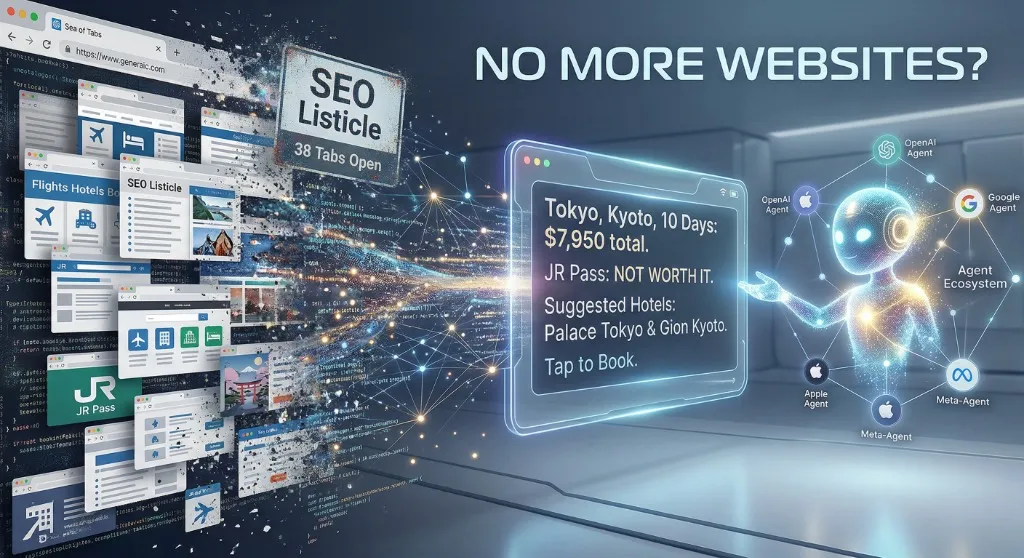
Where do you even begin? First, you open Google. You're met with a wall of SEO-driven listicles. You open the top five. That's five tabs. None of these articles agree. You open three new tabs to research the JR Pass. That's eight tabs. Then flights, hotels, and reviews. You're now at seventeen tabs and counting.
The web has not given you information; it has given you a part-time job. You are a frustrated logistics researcher buried in a sea of tabs, each one a biased, ad-filled, isolated piece of a puzzle you have to solve.
Now, look at the AI alternative. You provide one prompt with your budget and preferences. In ten seconds, you get a complete, synthesized plan. The AI answers the "delta" questions: Is the JR Pass worth it for this specific trip? The web gave you a sea of tabs. The AI gave you an actionable plan.
The "On-the-Fly" Smoking Gun: Google's Recent Patents
For years, this was theoretical. But recent developments have confirmed the strategy. Google has been granted patents (such as US12536233B1) regarding "AI-generated content pages tailored to a specific user." This isn't just a better search result; it's the end of the destination website as we know it.
The patents describe a system capable of:
Landing Page Scoring: Google evaluates a retailer's website. If the site is too clunky or isn't a "perfect match" for your intent, Google simply doesn't send you there.
Dynamic Reconstruction: Instead of a link, Google generates a bespoke landing page on the fly. It pulls the brand's data but rebuilds the interface, adding its own filters, buttons, and AI assistants, directly inside the Google ecosystem.
A2UI (Agent-to-User Interface): A protocol that allows AI agents to "speak UI." Instead of sending you text, the agent sends a payload that renders a custom, interactive dashboard designed just for that moment.
The takeaway: Google is no longer a map to the web. It is becoming the web itself.
The New Psychology: A World of Cognitive Offloading
This shift from a "pull" (searching) to a "push" (receiving) model is a profound psychological event. It will fundamentally rewire our expectations.
The Erosion of Human Agency: When an AI agent, which knows you prefer aisle seats and quiet hotels, can plan that entire Japan trip and simply ask for your credit card, the act of choosing is outsourced.
The Atrophy of Critical Thinking: The "sea of tabs," while frustrating, is a form of mental exercise. It forces you to compare, contrast, and detect bias. We are outsourcing not just facts, but the very process of problem-solving.
The New Baseline: "Perfect Personalization": We will demand that all information be instantly personalized and predictive. Anything less, like a static, one-size-fits-all website, will feel archaic and broken.
The Great Marketing Reset: From SEO to AO
If users no longer "visit" websites, the entire $600 billion digital advertising industry collapses. Marketing doesn't end, but it transforms into Agent Optimization (AO).
| Feature | Old World (SEO) | New World (AO) |
|---|---|---|
| Target | Human Eyeballs | AI Agents / Algorithms |
| Currency | Clicks & Traffic | Verifiable Data & Trust |
| Content | Persuasive Copy & Banners | Structured Data Feeds (APIs) |
| Goal | Rank #1 on a Page | Be the "Optimal" Recommendation |
The new field of AO is no longer about being seen by a human; it's about being the #1 choice recommended by the user's personal AI agent. Marketing becomes a battle of impeccable, verifiable data. One scandal or data-falsification event could get your brand "blacklisted" by the agents, effectively erasing you from commercial existence.
The Great Rebalancing: Winners and Losers
The Collapsing Old Guard: The digital advertising complex, SEO content farms, repetitive knowledge work (paralegals, market research), and "dumb" e-commerce sites whose data isn't live via an API.
The New Power Brokers: Agent Providers (OpenAI, Google, Apple), AO Specialists, AI Trust Auditors, and "Verifiable" Niche Brands that can prove their claims (e.g., blockchain-verified supply chains).
The Strategic Pivot: 3 Steps to Take on Monday
If the "Interface is Fading," you cannot wait for the transition to be over to react. You must stop building for the "human browser" and start building for the Agent Ecosystem.
1. Optimize for the "Landing Page Score": Google's patents suggest they score your page to determine if an AI should replace it. If your site is slow or hard to navigate, the AI will bypass you. Streamline your conversion paths now.
2. Move from "Copy" to "Documentation": AI agents don't care about clever headlines; they need hard, structured facts. Double down on Schema.org and ensure your pricing and specs are machine-readable. Your goal is to be the most "citable" source.
3. Build "Verifiable Trust" Signals: Agents will synthesize reviews and forum data (like Reddit) to make recommendations. Focus on E-E-A-T (Experience, Expertise, Authoritativeness, Trust). Secure third-party certifications and ensure your brand's reputation is consistent across the web.
The Interface is Fading
The website was a two-dimensional representation of information. A "place" we "visited." It was a profound, but temporary, metaphor. We are now moving from an internet of places to an internet of agents.
The question is no longer "Will the web be here forever?" but "Are you ready to be invisible to the humans, and indispensable to the machines?" Let's discuss what this means for your business.
Frequently Asked Questions
What is Agent Optimization (AO) and why does it matter?+
Agent Optimization is the successor to SEO. Instead of optimizing content for search engine results pages, businesses will need to optimize their data to be the top recommendation from a user's personal AI agent. This means providing perfect, structured, and verifiable data feeds rather than persuasive copy or flashy banners.
What are Google's AI-generated content page patents?+
Google has been granted patents such as US12536233B1 regarding "AI-generated content pages tailored to a specific user." These patents describe systems that score landing pages, dynamically reconstruct interfaces on the fly, and use A2UI (Agent-to-User Interface) protocols to render custom dashboards, effectively bypassing destination websites entirely.
How should businesses prepare for the agent economy?+
Businesses should focus on three things: optimizing for Google's "Landing Page Score" by streamlining conversion paths, moving from persuasive copy to machine-readable structured data and Schema.org documentation, and building verifiable trust signals through E-E-A-T, third-party certifications, and consistent online reputation.